
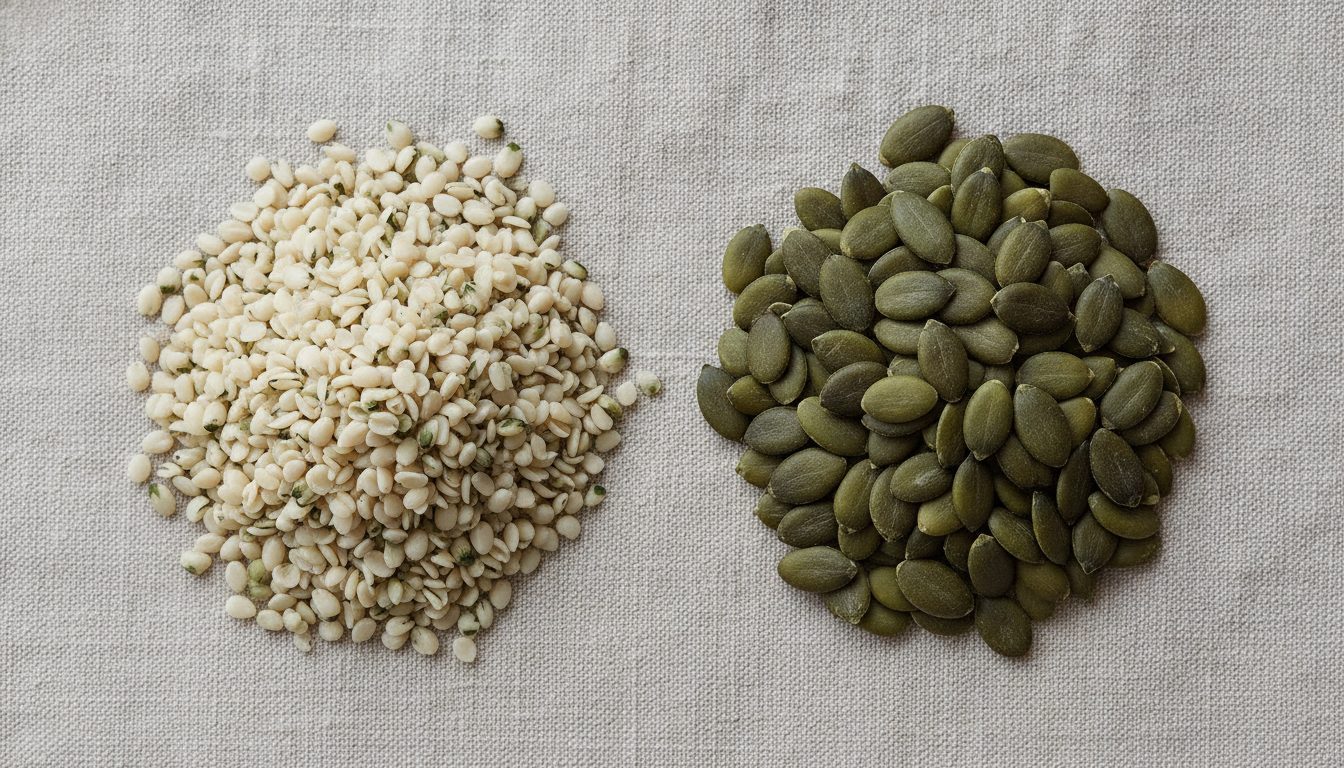
Hemp hearts and pepitas are the two green seeds most likely to end up in the same bowl. They look related, they occupy the same shelf, and almost everything about how they behave in food is different.
What is each one, physically?
Hemp hearts are hemp seed kernels with the hull mechanically removed. They are small, soft, pale green flecked with cream, and they collapse under light pressure. There is no crunch — bite one and it yields immediately.
Pepitas are pumpkin seeds without their white outer shell. Some pumpkin varieties produce seeds that grow hull-free naturally, which is where most commercial pepitas come from; others are hulled mechanically. They are larger, flatter, deeper green, and firm. Raw pepitas have a dense chew; roasted ones develop a genuine snap.
That structural difference drives everything downstream. One seed integrates into food; the other sits on top of it and provides contrast.
How do the nutrition profiles differ?
Both are respectable protein sources for a seed. A thirty-gram serving of hemp hearts supplies around ten grams of protein; pepitas land somewhat lower but still in a useful range. Both are calorie-dense, as any high-fat seed must be.
The meaningful divergence is in the fats. Hemp hearts are notable specifically for carrying a substantial quantity of alpha-linolenic acid, the plant omega-3, alongside their omega-6. Pumpkin seeds are dominated by linoleic acid and monounsaturated fat, with very little omega-3 to speak of. If omega-3 is the reason you are buying a seed, that difference alone settles it.
On minerals, both perform well and both lean toward magnesium. Pumpkin seeds have a particularly strong reputation for zinc, which is one of the more common reasons people add them deliberately. Hemp hearts contribute magnesium, phosphorus, iron and zinc in useful quantities too. Neither is a calcium source.
Fibre goes to pumpkin seeds. Hulling hemp removes most of its fibre, so hearts contribute little; pepitas retain noticeably more.
How do they behave in cooking?
This is where the two seeds part company entirely.
Hemp hearts cannot take sustained heat. Their fat is highly polyunsaturated and turns bitter under a broiler or in hot oil, so they belong stirred in at the end, blended into a cold sauce, or sprinkled on after cooking. They also blend to complete smoothness without soaking, which makes them exceptional in dressings, sauces and homemade milk.
Pumpkin seeds are built for heat. Toasting them in a dry pan is the standard preparation, and it improves them considerably — the flavour deepens, they puff slightly, and the texture becomes genuinely crisp. They hold that crispness on top of a salad or a soup for far longer than most toppings. They do not blend smooth without effort, and a pepita sauce will have body and texture rather than silkiness.
The corollary is that substituting one for the other rarely works. Hemp hearts on a soup that wanted the crunch of toasted pepitas will disappoint. Pepitas stirred into yogourt where hearts would have vanished will feel like a separate ingredient you have to chew through.
Which one for which dish?
| Use | Better choice | Why |
|---|---|---|
| Yogourt, oatmeal, smoothies | Hemp hearts | Soft texture integrates instead of intruding |
| Salad topping for crunch | Pumpkin seeds | Toasted crispness holds up against dressing |
| Creamy dressings and sauces | Hemp hearts | Blend smooth with no soaking |
| Garnish on soup or chili | Pumpkin seeds | Survive contact with hot liquid |
| Granola and baked bars | Pumpkin seeds | Tolerate oven heat without turning bitter |
| Snacking straight from the jar | Pumpkin seeds | Hearts are too soft to satisfy as a snack |
| Adding protein without changing a dish | Hemp hearts | Mild and texturally invisible |
Are there practical differences beyond nutrition?
Storage is one. Both are high-fat seeds that keep best cold, dark and sealed, but hemp hearts are the more fragile of the two because their fat is more polyunsaturated. Pepitas are more forgiving of a cupboard, particularly if they are raw and whole. Neither belongs in a clear jar on a sunny counter.
Allergen considerations differ as well. Neither is a tree nut, and neither is among the most common allergens, but pumpkin seeds have a longer history in mainstream cooking and are more widely recognized on menus and labels. If you are cooking for others, hemp is more likely to prompt questions — mostly about cannabis, which are worth answering plainly rather than avoiding.
Cost varies too much by region and season to generalize responsibly, but as a rule of thumb, buying either in a larger bag from a shop with real turnover beats buying a small package that has been sitting.
Should you just use both?
Honestly, yes, and not as a compromise. These two seeds are close to ideal complements: hemp hearts supply omega-3 and disappear into soft foods; pumpkin seeds supply crunch, fibre and zinc and stand up to heat. A salad topped with both gets contrast from one and nutrition from the other with no redundancy.
The one thing worth avoiding is buying large quantities of each at the same time. High-fat seeds reward turnover, and two half-finished bags degrading in parallel is worse than one bag used properly. Buy a moderate amount of each, keep both in the fridge, and let the dish decide which jar you reach for. Comparisons against the other seeds people ask about — flax, chia, sunflower — are set out across our articles.
If you can only keep one, let the question be what you actually eat. If your food is soft — yogourt, porridge, smoothies, sauces — hemp hearts will get used and pepitas will sit. If it is salads, soups, granola and snacking, pumpkin seeds will earn their space and hemp hearts will slowly go stale. The better seed is the one that matches your kitchen, not the one that wins on paper.