
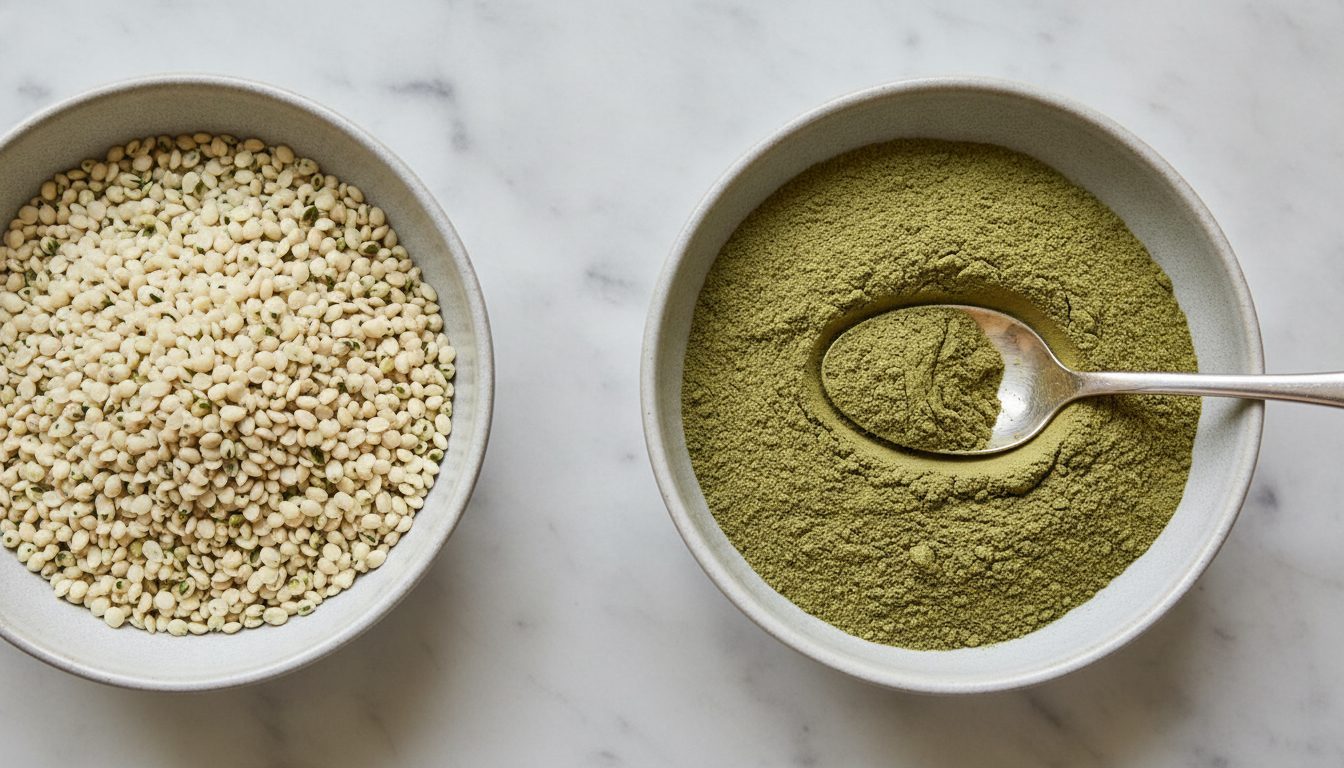
Hemp hearts and hemp protein powder sit beside each other in the same aisle, made from the same crop, and shoppers routinely treat them as interchangeable. They are not. One is the intact kernel; the other is what remains after the oil has been squeezed out of it.
How is each one made?
Hemp hearts are whole hemp seed with the hull mechanically removed. Nothing is added and nothing is extracted — you are eating the kernel exactly as the plant assembled it, complete with its fat, protein, fibre and minerals in their original proportions.
Hemp protein powder starts from the same seed but takes a further step. The seed is pressed to extract oil, which is sold separately. What remains is a solid cake, dense in protein because a large share of the calories left with the oil. That cake is milled into powder, and in some products sieved to remove fibre, which raises the protein percentage further. This is why protein content varies so much between brands — a sieved product and an unsieved one are meaningfully different foods sold under similar names.
Neither process is chemically aggressive. The difference between the two products is subtraction, not treatment.
How much protein does each actually deliver?
Per equal weight, hemp protein powder wins clearly. A thirty-gram serving of hemp hearts supplies around ten grams of protein. The same weight of protein powder supplies substantially more, with the exact figure depending on how thoroughly the fibre was removed — read the panel, because the range across products is wide.
Per calorie, the gap is even larger. Hemp hearts carry their protein alongside a large quantity of fat, so getting more protein means taking on proportionally more calories. Protein powder has had most of that fat removed, which is exactly the point: it delivers protein without the accompanying energy load.
Where hearts pull back some ground is in the surrounding package. You are not only buying protein — you are also getting alpha-linolenic acid, magnesium, phosphorus and the rest of the seed's mineral content, in a food you can eat with a spoon. Whether that is a benefit or a complication depends entirely on what you were trying to achieve.
What about fat and fibre?
This is the difference that decides most purchases. Hemp hearts are roughly half fat by weight, dominated by polyunsaturated fatty acids including a genuinely useful quantity of omega-3 ALA. Hemp protein powder retains only residual fat — the oil is the product being separated out — so anyone buying hemp specifically for its fatty acid profile is buying the wrong item if they reach for the powder.
Fibre runs the other way. Hulling removes most of hemp's fibre, so hearts are not a fibre food. Protein powder, particularly the unsieved kind, retains considerably more, which is why it thickens liquids and why it has a reputation for a heavy, earthy texture. If your digestion is sensitive, that fibre is worth knowing about before you commit to a large tub.
Which one tastes better?
Hemp hearts, without much argument. They are soft, mildly nutty and easy to eat repeatedly without becoming tiresome. They disappear into yogourt, oats, smoothies, dressings and warm grains, and they do not need to be disguised.
Hemp protein powder is more assertive: earthy, distinctly green, and gritty in a way that some people never come to like. It performs acceptably in a strongly flavoured smoothie with banana, cocoa or berries, and poorly in anything delicate. It is also more noticeable in baking than hearts are, and can make a bake dry, since it absorbs liquid the way hearts do not.
Practically, this is why hearts survive in most households and powder often does not. A bag of hearts gets used because using it is easy. A tub of protein powder gets used enthusiastically for two weeks and then sits.
Which should you buy for your goal?
- General nutrition, daily habit, whole-food preference: hemp hearts. They give protein, omega-3 fats and minerals in one ingredient with no preparation.
- Hitting a specific daily protein target: protein powder, or more likely a blend that includes it. Reaching a high target with hearts alone means a very high fat intake.
- Protein while controlling calories: powder. This is the one goal hearts genuinely cannot serve.
- Omega-3 ALA: hearts, unambiguously. The powder has had the fat removed.
- Cooking and eating rather than supplementing: hearts. They behave like food; powder behaves like an ingredient with conditions attached.
- Digestive support: neither is ideal, but the powder retains more fibre.
Comparisons with other hemp products, including hemp seed oil and whole unhulled seed, are laid out across our articles.
Does it make sense to use both?
For most people, no. Two hemp products competing for the same shelf space usually means one of them expires. But there is a coherent case for the pair if you have distinct needs: hearts as the everyday food, added to whatever you already eat, and powder held in reserve for training days or for a smoothie that needs to carry more protein than fat.
If you do keep both, buy the powder in the smallest reasonable quantity. It is the one more likely to go unused, and it is not immune to going stale — the residual fat still oxidizes, and a large tub opened for occasional use will eventually taste worse than it did.
If you are choosing one item today and you do not have a numerical protein target, buy the hearts. They are the more complete food, the more pleasant one, and the one you will still be using in three months. Add powder only when you have identified a specific gap that hearts genuinely cannot fill without bringing too much fat along with them.