
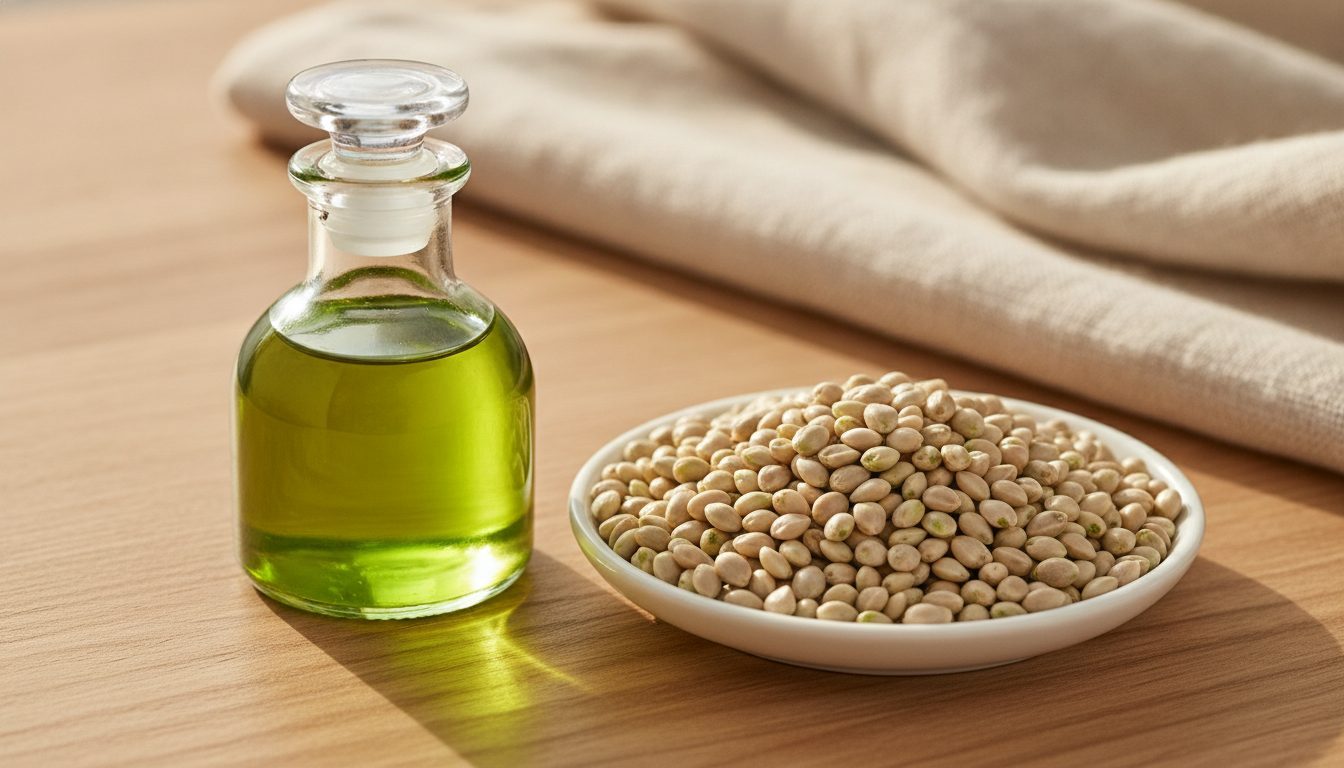
Hemp seed oil and hemp hearts are the same crop separated into parts. The oil is one fraction of the kernel, bottled alone — and knowing precisely what did not come along with it tells you which one belongs in your kitchen.
What does pressing actually remove?
Hemp seed oil is produced by mechanically pressing the seed, usually without added heat beyond what friction generates. Oil flows out; everything else stays behind as a solid cake, which is later milled into hemp protein powder or used as animal feed.
What ends up in the bottle is the fat, along with the fat-soluble compounds that travel with it. What stays in the cake is the protein, the fibre, and most of the mineral content — magnesium, phosphorus, iron, zinc and the rest are not fat-soluble and do not follow the oil out.
So the trade is clean and easy to state. The oil concentrates the fatty acid profile and discards everything else. Hemp hearts keep the whole package in its original proportions, which means less concentrated fat per spoonful but nothing missing.
Are the fats identical?
Compositionally, close to it. The oil in a hemp heart and the oil in a bottle of hemp seed oil come from the same source, with the same predominance of polyunsaturated fatty acids — linoleic acid and alpha-linolenic acid at roughly three to one, plus a small amount of gamma-linolenic acid.
The difference is concentration and exposure. A tablespoon of oil is pure fat, so it delivers the fatty acid load far more efficiently than the equivalent tablespoon of hearts. If your specific objective is a measured dose of ALA with minimal volume, the oil does that job better.
But concentration cuts both ways. Inside an intact kernel, the oil is protected — held within cell structures, surrounded by protein, shielded from oxygen. Pressed into a bottle, it is fully exposed. This is why hemp seed oil is markedly more fragile than hemp hearts and needs more careful handling.
How do shelf life and heat tolerance compare?
Hemp seed oil is among the more perishable culinary oils on the shelf. It is normally sold in dark glass, frequently refrigerated in store, and carries advice to keep it cold once opened and to use it within a few weeks. That advice is not decoration. Highly polyunsaturated oil in a bottle oxidizes readily, and rancid hemp oil is unpleasant enough that you will not need a test to detect it.
Hemp hearts, with the fat still enclosed in the kernel, hold up considerably better. They still want cold, dark storage, but the timescale is more forgiving and the failure is slower.
Neither belongs in a hot pan. Hemp seed oil in particular has a low smoke point and should be treated as a finishing oil exclusively — poured over food after cooking, whisked into dressings, drizzled on soup. Frying with it damages the fatty acids you paid for and produces a bitter result. Hemp hearts are more tolerant only because their exposure is lower; they too should be added at the end of cooking rather than the start.
When is the oil the better choice?
There are real situations where the oil wins:
- You want the fatty acids without texture. Anyone who dislikes the feel of seeds, or who is feeding someone with texture aversion, gets the fats with none of the mouthfeel.
- You need to replace an oil, not add a topping. Swapping part of the oil in a vinaigrette shifts the fat profile of the dish without adding solids.
- Dose precision matters. A measured tablespoon is easier to track than an estimated handful of seeds.
- Very low-fibre or texture-restricted eating. Some medical diets exclude seeds outright while permitting oils.
And where hearts win: any time you want protein, minerals and satiety alongside the fats; any time you want a single ingredient rather than two; any time storage discipline is unreliable, since a forgotten bottle of hemp oil goes bad faster than a forgotten bag of hearts; and any time you want to eat something rather than pour something.
Is buying both worth it?
Only if you will genuinely use both within their windows. The most common outcome of buying hemp seed oil alongside hearts is a half-full bottle at the back of a fridge shelf that eventually gets poured away — which wastes both the money and the nutrition.
A workable pattern for people who really do want the pair: use hearts as the daily habit, added to breakfast and stirred into savoury food, and buy the smallest bottle of oil available for a specific recurring use — one dressing you make every week, or a finishing drizzle on a dish you actually cook. A defined job keeps the bottle moving. Buying it as a general health measure, with no assigned use, almost guarantees waste.
If cost per unit of nutrition drives your decision, hearts are usually the better value simply because you are buying the whole seed rather than one extracted fraction of it, and comparisons with the other hemp formats are covered across our articles.
Does the same reasoning apply to whole seed?
Broadly, yes, running in the opposite direction. Whole unhulled hemp seed is the most complete form of all — hull, fibre, kernel and oil together — but the hull makes it fibrous, gritty and considerably harder to eat in quantity. Hearts sit in the middle: the hull removed for palatability, everything else intact. Oil sits at the far end: maximum concentration of one component, everything else gone.
Seen that way, the three products form a spectrum rather than a set of competitors, and your position on it should follow your goal rather than the marketing.
For most kitchens, hemp hearts are the sensible default: they carry the same fats in a more stable form, they bring the protein and minerals along, they store forgivingly, and they need no separate occasion to be used. Reach for the oil when you have a specific, repeating use for a finishing oil — and when you do, buy small, keep it cold and dark, and finish it before it turns.