
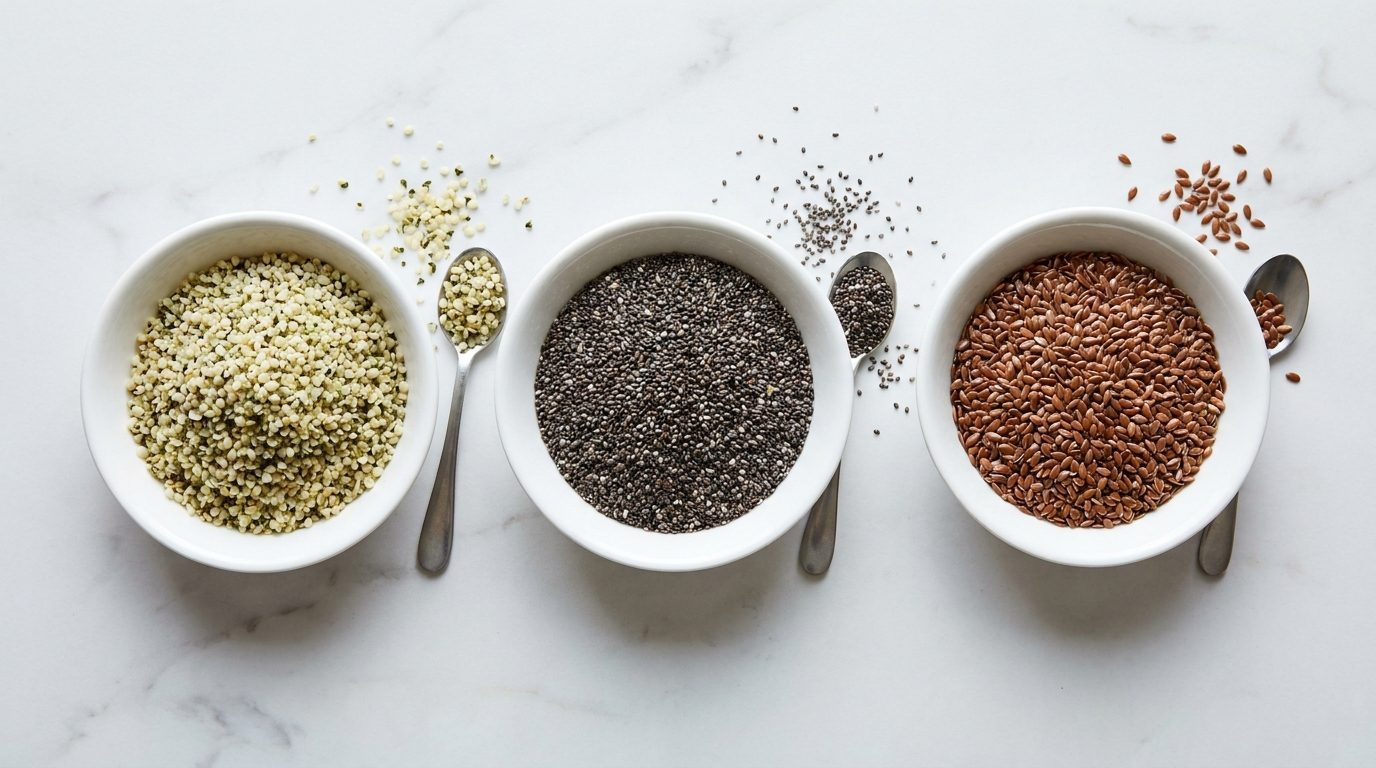
Hemp hearts, chia, and flax are the three seeds most likely to end up in the same shopping cart, and they are constantly treated as interchangeable. They are not. Each one is genuinely better than the other two at something specific, so the right answer depends entirely on what you are trying to add to your diet.
What is each seed actually best at?
Before comparing numbers, it helps to know the single thing each seed does better than the others. That one strength is usually the reason to reach for it.
- Hemp hearts are the protein and mineral pick. They deliver the most complete protein of the three and exceptional magnesium, in a soft kernel you can eat raw with no preparation.
- Chia is the fibre and gelling pick. Its soluble fibre absorbs many times its weight in liquid, forming a gel that thickens puddings, drinks, and overnight oats while contributing substantial fibre per spoonful.
- Flax is the omega-3 pick. Ground flax carries the highest concentration of plant-based omega-3 ALA of any common seed, and it is the cheapest of the three per serving.
If you stop reading here, that summary alone answers most shoppers' question. The rest fills in the trade-offs.
How do hemp hearts, chia, and flax compare nutritionally?
The table below uses a 30 gram serving (roughly three tablespoons) so the three line up fairly. Chia and flax figures are typical ranges for the whole seed; flax assumes ground, since whole flax passes through largely undigested.
| Per 30 g | Hemp hearts | Chia | Flax (ground) |
|---|---|---|---|
| Calories | 166 | ~145 | ~160 |
| Protein | 10 g (complete) | ~5 g | ~5 g |
| Fat | 14 g | ~9 g | ~13 g |
| Fibre | 1.2 g | ~10 g | ~8 g |
| Omega-3 ALA | 2.5 g | ~5 g | ~6.5 g |
| Net carbohydrate | ~1.4 g | ~2 g | ~0.5 g |
| Magnesium | 210 mg | ~95 mg | ~110 mg |
| Texture | Soft, eat raw | Gels in liquid | Must be ground |
The pattern is clear once you read down the columns. Hemp hearts dominate protein and magnesium and carry almost no fibre. Chia and flax flip that: far more fibre and omega-3, much less protein. Flax edges chia on omega-3; chia edges flax on fibre and convenience.
Which seed has the most usable protein?
Hemp hearts win this decisively, and not only on quantity. At roughly 10 grams per 30 gram serving, hemp hearts carry about double the protein of chia or flax. More importantly, hemp protein is complete: it contains all nine essential amino acids in workable proportions, with an overall profile closer to dairy than most plant foods.
Chia and flax do contain protein, but at around 5 grams per serving it is a supporting contribution rather than a reason to buy them. If your goal is to raise the protein content of a smoothie, yogurt bowl, or baked good, hemp hearts are the only one of the three that moves the needle meaningfully. The other two are chosen for fibre and fats, with protein as a minor bonus.
Which is best for fibre and digestion?
This is where hemp hearts come last, and by a wide margin. Because the fibrous outer shell is removed to make hemp hearts, they carry only about 1.2 grams of fibre per serving. Chia and flax keep their hulls and deliver roughly eight to ten grams in the same amount, several times more.
The two high-fibre seeds work differently, though:
- Chia is rich in soluble fibre that forms a gel in liquid. That gel slows digestion, adds a feeling of fullness, and is the reason chia thickens puddings and drinks. It is often the seed people reach for when regularity is the goal.
- Flax provides a mix of soluble and insoluble fibre, plus lignans, plant compounds that have drawn research interest. Flax must be ground to release its nutrients and fibre benefits; whole flax seeds largely pass through intact.
A practical note: if you are increasing fibre from a low baseline, add chia or flax gradually and drink enough water. A sudden jump from several grams of new fibre, especially the gelling kind in chia, can cause bloating or discomfort. Hemp hearts, being low in fibre, do not carry that adjustment concern.
Which seed gives you the most omega-3?
Flax leads, chia is close behind, and hemp hearts come third. All three provide alpha-linolenic acid (ALA), the plant form of omega-3. Ground flax carries the densest concentration, which is its headline nutritional claim. Chia is not far off, and hemp hearts provide a respectable but smaller amount at about 2.5 grams per serving.
One honest caveat applies to all three equally: ALA is not the same as the longer-chain omega-3s (EPA and DHA) found in fish and algae. The body converts ALA to EPA and DHA at low efficiency. So none of these seeds is a direct substitute for fish oil or an algae supplement if EPA and DHA are specifically what you are after. Where hemp hearts pull ahead is the balance of fats: their omega-6 to omega-3 ratio is generally considered favourable, alongside a small amount of the less common fatty acid GLA.
How do they differ in preparation and taste?
Convenience often decides which seed you actually keep using, and here the three diverge sharply.
- Hemp hearts need no preparation at all. They are soft, mild, and slightly nutty, and you can eat them straight from the bag or stir them into anything. There is nothing to grind, soak, or gel.
- Chia can be eaten dry but is at its best soaked, where it forms its signature gel. Dry chia sprinkled on food is fine; chia given ten minutes in liquid becomes pudding. Its flavour is very neutral.
- Flax realistically must be ground to be useful, since whole seeds pass through undigested. Ground flax also goes rancid faster than whole, so many people grind small batches or buy ground flax and refrigerate it. Its flavour is nuttier and more pronounced than the other two.
For someone who wants to add a seed with the least friction, hemp hearts are the obvious choice: no grinder, no soaking time, and a taste mild enough to disappear into almost any dish. For more on how the hulled kernel behaves across recipes and storage, the full set of guides is in our article index.
So which one should you add?
Match the seed to your actual goal rather than buying all three on autopilot:
- Choose hemp hearts if you want complete protein, high magnesium, and zero preparation. They are the best everyday topping for yogurt, oatmeal, salads, and smoothies, and the easiest to eat on their own.
- Choose chia if you want gelling soluble fibre and a thickener for puddings, drinks, and overnight oats, or if digestive regularity is the priority.
- Choose flax if you want the highest plant omega-3 and lignans at the lowest cost, and you are willing to grind it and keep it refrigerated.
In practice, many people end up using two of them for complementary reasons, and that is sensible: hemp hearts for protein, plus chia or flax for fibre and extra omega-3. They are not competitors fighting for one spot in your pantry so much as specialists. The mistake is treating any one of them as a do-everything seed. Start with the strength you most want to add, keep that seed where you will actually reach for it, and add a second only when there is a second goal it genuinely serves.