
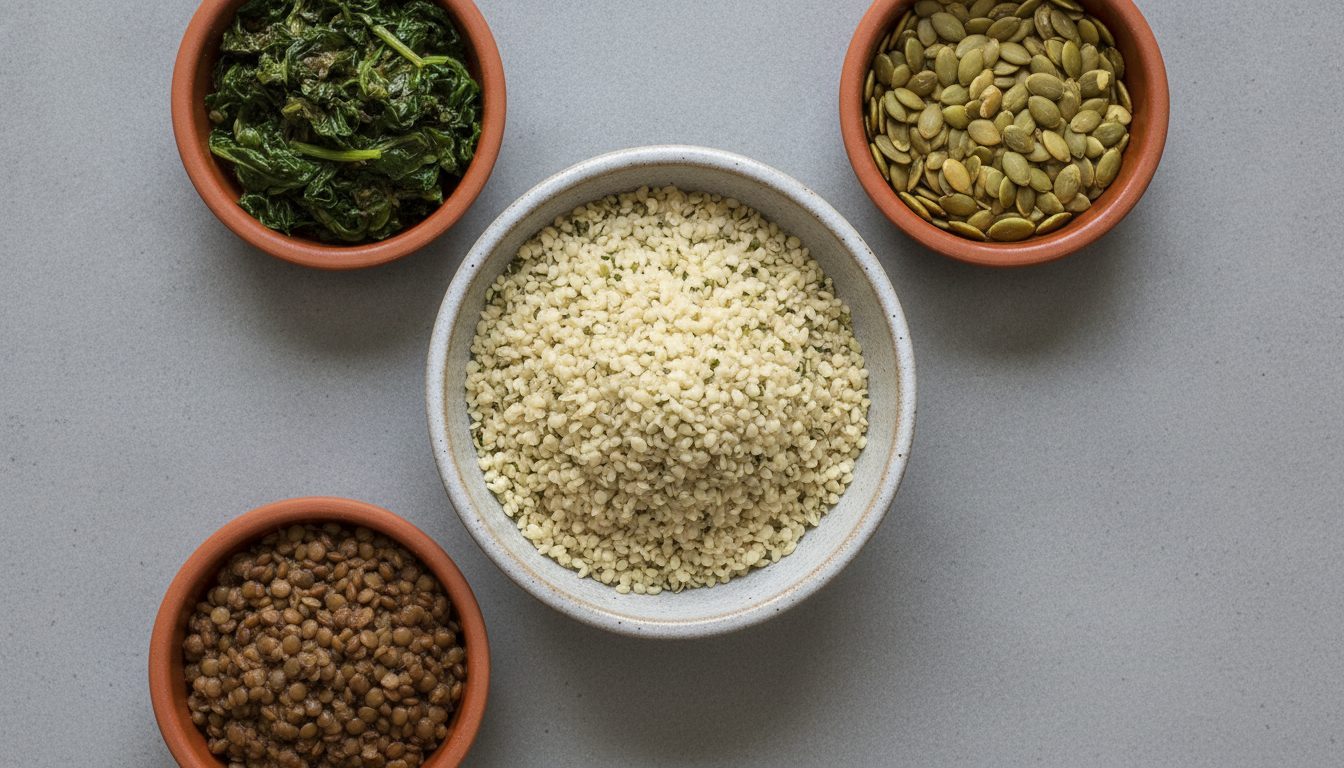
Protein and omega fats get all the attention, but the mineral content is one of the quieter reasons a daily spoonful of hemp hearts is worth the habit. It is also where the difference between what a label says and what your body absorbs is largest.
Which minerals do hemp hearts actually supply?
Seeds are storage organs. A plant packs a seed with everything a seedling needs to establish itself before it can draw from soil, and minerals are a large part of that provisioning. Hemp hearts follow the pattern, and the standouts are magnesium and phosphorus, followed by useful quantities of iron, zinc, manganese, copper and potassium.
Magnesium is the one worth naming first. A typical three-tablespoon serving supplies a substantial share of a day's magnesium — enough that hemp hearts belong on the short list of foods you would suggest to someone whose intake is habitually low. Phosphorus is abundant for the same structural reason: much of it is bound up in the seed's phosphorus storage compound, which is directly relevant to the absorption question further down this page.
Two things hemp hearts are not: a calcium source of any consequence, and a meaningful source of sodium. If you are reaching for hearts to address calcium, they are the wrong tool.
Why does magnesium stand out?
Partly because hemp carries a lot of it, and partly because magnesium is one of the minerals that a modern diet built on refined grains tends to underdeliver. Whole grains, legumes, leafy greens, nuts and seeds are the main dietary sources, and diets light on all five categories at once are not unusual.
Magnesium is involved in an enormous number of enzymatic reactions, including those governing muscle and nerve function and energy metabolism. That breadth is exactly why you should be cautious about anyone attributing specific symptom relief to a magnesium-containing food — a nutrient involved in everything is easy to blame for anything. The defensible claim is narrower and still worth making: if your intake is below where it should be, a food that reliably contributes magnesium every day, without a supplement, is a good structural fix.
What is the difference between content and absorption?
A nutrition panel reports how much of a mineral is present in the food. It does not report how much crosses your intestinal wall, and for plant foods the gap can be considerable.
The main reason in seeds is phytic acid, the compound plants use to store phosphorus. Phytic acid binds positively charged minerals — iron, zinc, magnesium, calcium — into complexes that the human gut absorbs poorly. Hemp hearts contain phytic acid, as do essentially all seeds, nuts, whole grains and legumes. Hulling helps somewhat, since some of the phytate resides in the outer layers, but it does not eliminate it.
The second reason is the form the mineral takes. Iron in plants is non-heme iron, which is absorbed far less efficiently than the heme iron in meat and is much more sensitive to what else is in the meal. The iron figure on a bag of hemp hearts is real, but it should be mentally discounted relative to the same number attached to a serving of beef.
None of this makes plant minerals unimportant. Populations eating plant-heavy diets meet their needs routinely. It means the sensible reading of a mineral figure is "a real contribution, partially absorbed" rather than a deposit into an account.
What actually improves mineral uptake?
A handful of practical levers do more than any single-food choice:
- Add vitamin C to the same meal. This is the strongest and best-established lever for non-heme iron. Berries in the yogourt, citrus in the dressing, tomato or peppers in the salad — all of them help iron from hemp hearts and any other plant food in the same sitting.
- Move tea and coffee away from the meal. The polyphenols in both interfere meaningfully with non-heme iron absorption. A gap of an hour on either side is enough to matter.
- Spread intake out. Absorption of several minerals is more efficient at smaller doses. Three tablespoons at breakfast and three at dinner beats six at once, which is convenient because that is also the more comfortable way to eat them.
- Vary your sources. Different foods bring different limiting factors. Combining hemp with legumes, greens and whole grains covers the gaps better than doubling down on one seed.
What is not worth doing is soaking or sprouting hemp hearts to reduce phytate. Those techniques work on whole grains and legumes, but a dehulled kernel cannot germinate and will simply turn mushy and start to spoil. The technique does not transfer.
Who gets the most out of hemp hearts as a mineral source?
Three groups in particular. People eating a fully plant-based diet, who need multiple non-meat iron and zinc contributors and benefit from one that also carries protein and fat. People whose diets are built on refined grains, where magnesium and manganese are systematically thin. And people who struggle to eat large volumes of food — a small, calorie-dense addition that carries minerals is more useful to them than a large salad.
The group that gains least is anyone already eating a wide mix of legumes, whole grains, greens, nuts and seeds. There is nothing wrong with adding hemp hearts to that diet, but the marginal mineral gain is small and the better reasons to eat them are the protein, the fats and the convenience. Those other angles are examined across our articles.
The practical version of all this fits in a sentence: keep a jar of hearts in the fridge, use two smaller servings a day rather than one large one, and make sure at least one of them lands in a meal that also contains something rich in vitamin C. That combination costs no extra effort and converts more of what is printed on the panel into something your body can actually use.