
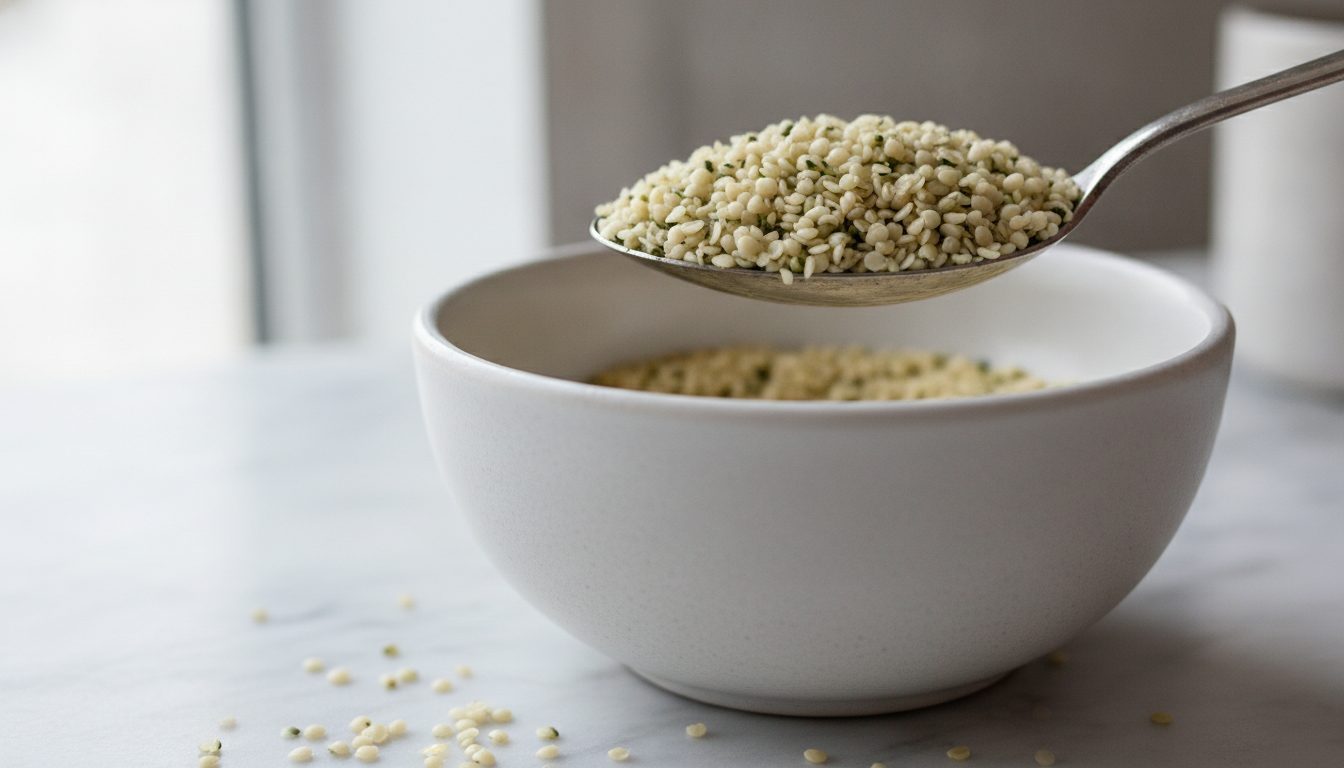
Hemp hearts are marketed as a complete plant protein almost without exception. The claim holds up better than most seed-aisle marketing — but "complete" answers a narrower question than shoppers think it does.
What does "complete protein" actually mean?
There are nine amino acids the human body cannot synthesize and must take in from food. A protein source is conventionally called complete when it contains all nine in reasonable proportion, rather than being effectively missing one. Animal proteins, soy and quinoa are the usual examples; most grains and legumes are described as incomplete because one particular amino acid runs low relative to the others.
Hemp hearts do contain all nine. That is a factual statement about the amino acid profile, and it is why the claim appears so widely. What it does not tell you is how much protein you get per serving, how well your body breaks that protein down, or whether any single amino acid is present at a level that limits how usefully the rest can be applied. Completeness is a pass or fail on one narrow test, not a ranking.
What proteins are actually in a hemp seed?
Two protein families make up most of hemp's protein, and the balance between them is part of why hemp behaves the way it does in food.
The larger share is edestin, a globulin storage protein. It is the classic hemp protein, and it is notable for forming a fairly loose, digestible structure rather than a tough, tightly folded one. The second is albumin, a water-soluble protein present in a smaller proportion but with a favourable amino acid profile of its own.
Practically, the protein in hemp hearts is not locked behind heavy processing requirements. Unlike some legume proteins that need cooking to be usefully available, hemp's proteins are reasonably accessible from raw seed. This is one of the reasons hemp hearts work as a stir-in ingredient rather than requiring a cooking step, and why blending them into a dressing or a smoothie does not waste the protein.
Is lysine the weak link?
Among the nine essentials, lysine is the one that runs relatively lowest in hemp, as it does in many seeds and grains. It is present, which is why the completeness claim stands, but it is the amino acid closest to being limiting.
This matters far less than it sounds if you eat a varied diet. The old advice about carefully combining complementary proteins within a single meal has been substantially relaxed; what your body works with is the pool of amino acids assembled across the day, not the composition of one bowl. Legumes — beans, lentils, chickpeas, peas — are generously supplied with lysine, so anyone eating legumes anywhere in their week is covering the gap without planning for it.
Where it deserves genuine attention is at the extremes: a diet built almost entirely on seeds, nuts and grains with legumes absent, or a very low total protein intake where every source is being asked to do a lot of work. In those cases the shape of the profile starts to matter.
Completeness or digestibility: which matters more?
Modern protein quality assessment does not stop at the amino acid list. It combines the profile with how much of the protein actually survives digestion and gets absorbed. A source can be complete on paper and still perform modestly if its protein is poorly digestible, or if fibre and antinutrients in the surrounding food matrix interfere.
Hemp's position here is reasonable rather than spectacular. Hulled seed removes most of the fibrous hull, which helps — whole hemp seed's protein is harder to access than the same protein in hearts. Hemp is not going to outperform whey, egg or isolated soy protein on a digestibility-adjusted basis, and any source claiming otherwise is overselling. Against other whole seeds and nuts, however, hemp hearts do well, and they do it without requiring a processing or extraction step.
How much protein does a realistic serving deliver?
This is where expectations most often go wrong. A standard serving of hemp hearts is around three tablespoons, roughly thirty grams, and delivers about ten grams of protein — a genuinely useful amount for a topping, and about what you would get from a large egg or a small serving of yogourt.
The constraint is that hemp hearts are a high-fat food. Scaling the protein up means scaling the fat and calories up with it, because they arrive in fixed proportion. Consider what that means in practice:
- Three tablespoons is a topping: meaningful protein, comfortable calories, easy to repeat daily.
- Six tablespoons starts to be a fat-dominant contribution to the meal, and some people find it sits heavily.
- Attempting to build a large share of daily protein from hearts alone means a very fat-heavy diet, which is usually not what the person wanted.
If the goal is protein per calorie rather than protein plus fats and minerals, hemp protein powder is the tool designed for that job, and the comparison between the two is covered in our articles.
How should you actually use hemp hearts for protein?
The sensible role is as a consistent contributor rather than a headline source. Ten grams added to a breakfast that was otherwise low in protein reshapes that meal considerably — porridge, toast and fruit are all weak on protein, and hemp hearts fix that without adding a cooking step or a new dish to wash.
Spreading intake across meals is more useful than concentrating it. Hearts on morning oatmeal, blended into a lunchtime dressing and stirred into a soup at dinner adds up to a substantial daily contribution while keeping any single serving small enough to be comfortable. Because the flavour is mild, this is one of the few protein additions that can survive daily repetition without becoming tiresome.
So the answer is yes with an asterisk: hemp hearts contain all nine essential amino acids, with lysine as the relative weak point and digestibility that is good for a whole seed but not comparable to isolated animal or soy protein. Treat them as a reliable ten-gram upgrade to meals that were short on protein anyway, keep legumes somewhere in your week, and stop worrying about combining anything within a single sitting.