
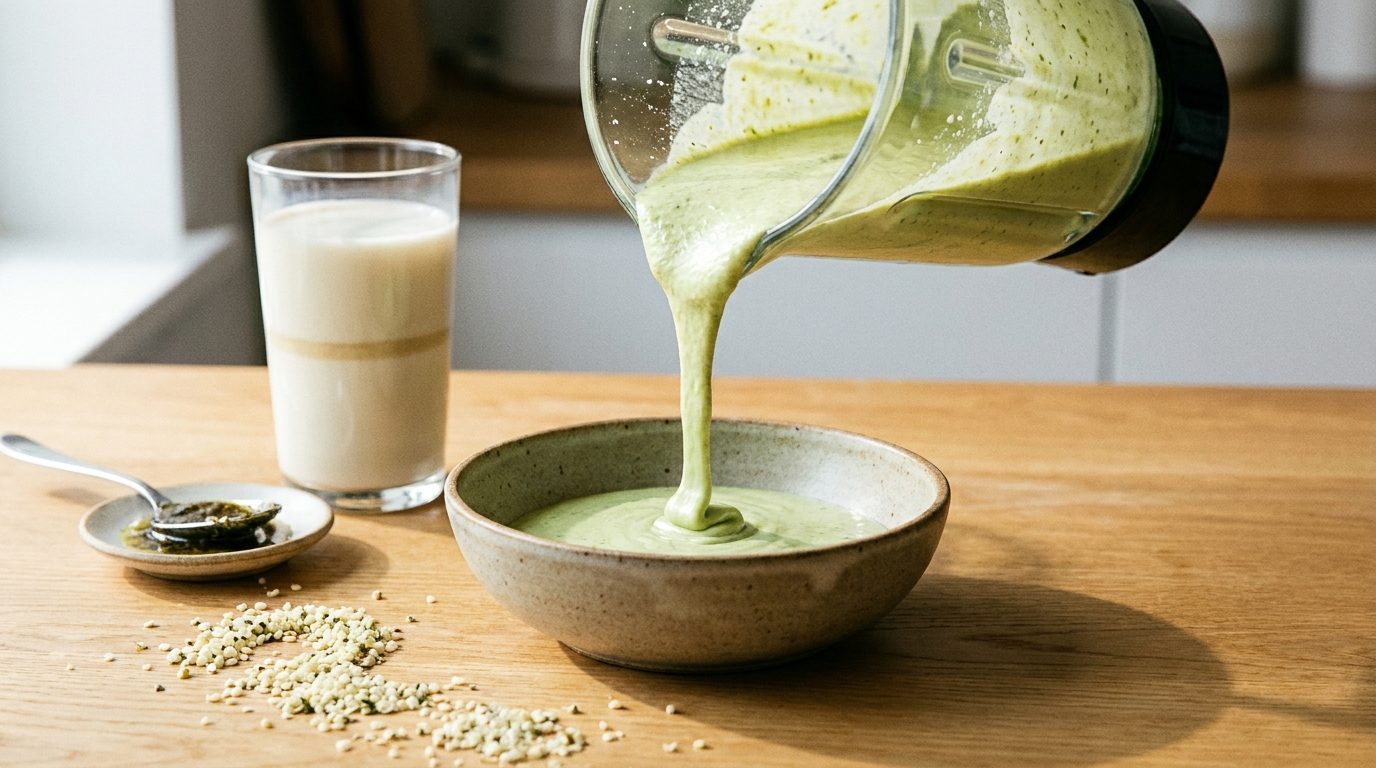
Hemp hearts have no hull and a soft, oil-rich kernel, which means a blender breaks them down completely without soaking, straining or any advance planning. That single property makes them the most forgiving seed in the kitchen for anything creamy.
Why do hemp hearts blend so easily?
Most seeds and nuts need help before they will go smooth. Almonds and cashews are dense and fibrous and want a soak. Whole seeds carry hulls that survive blending as grit no matter how long the machine runs. Hemp hearts have neither problem: the hull is already gone, the kernel is soft enough to crush between your fingers, and roughly half its weight is oil that emulsifies the moment it is released.
What you get is a natural emulsifier that also carries protein. When you blend hemp hearts into an acidic liquid, the released oil and the seed's protein together hold the mixture in suspension, which is why a hemp-based dressing stays creamy without mustard, egg or gum. It is the same principle that makes hemp milk work without additives.
A standard household blender handles all of this. An immersion blender works for dressings and sauces but struggles with milk, where you want more force and a longer run.
Creamy lemon and garlic dressing
This replaces a mayonnaise- or yogourt-based dressing and keeps for several days in the fridge.
- 60 mL (4 tbsp) hemp hearts
- 80 mL water, plus more to thin
- Juice of one lemon
- 1 small garlic clove
- 15 mL (1 tbsp) olive oil
- Salt and pepper
Blend everything on high for about a minute, until there is no grain left on the tongue. It will look thin for the first twenty seconds and then thicken abruptly as the seeds break and emulsify — do not add more hearts before that happens. Thin with water a spoonful at a time to reach the consistency you want; it firms up further in the fridge, so aim slightly looser than your target.
Variations that work without changing the method: swap the lemon for lime and add cilantro; add a spoonful of tahini for a heavier, more savoury version; add a small piece of pickled jalapeño for heat that blends in smoothly.
Green herb sauce
A pesto in structure but cheaper and softer than the pine nut original, and it does not need cheese to taste complete.
- 80 mL (about 5 tbsp) hemp hearts
- A large, generously packed handful of soft herbs — basil, parsley, cilantro or a mix
- 1 garlic clove
- 60 mL olive oil
- Juice of half a lemon
- Salt
Pulse the hearts, garlic and herbs together first, scraping down the sides, then run the machine and pour the oil in steadily. Finish with lemon and salt. The result is looser than a traditional pesto and greener, because hemp hearts contribute their own vegetal note rather than the resinous one pine nuts bring.
It goes on pasta, roasted vegetables, grain bowls, eggs and fish. Do not cook it — spoon it over hot food instead, both because the herbs will dull and because hemp's fat does not like sustained heat. Press a thin layer of oil over the surface before refrigerating to keep the colour from browning.
Homemade hemp milk
Hemp milk is the one nut-style milk that needs no soaking and, for most people, no straining.
- 125 mL (1/2 cup) hemp hearts
- 750 mL to 1 litre water, depending on how rich you want it
- Optional: a pinch of salt, a date or a small spoonful of maple syrup, a splash of vanilla
Blend on the highest setting for a full sixty to ninety seconds. Stop early and you will get a chalky texture; the extra time is what turns the seed particles fine enough to stay suspended. Taste before deciding whether to strain — many people find unstrained hemp milk perfectly smooth, and straining removes protein and fibre along with the texture. If you want it silkier, pass it through a fine sieve or a nut milk bag.
Use the higher water volume for drinking and cereal, the lower one for coffee or cooking. It will separate in the fridge, which is not a fault; shake the jar. Treat it as a fresh product and finish it within a few days, and expect it to behave differently from dairy under heat — it can look grainy if boiled hard, so warm it gently.
What goes wrong, and how do you fix it?
| Problem | Cause | Fix |
|---|---|---|
| Gritty or chalky | Not blended long enough | Run it another 30-60 seconds; scrape the sides once |
| Bitter aftertaste | Old seed, or over-blending until the mixture warms | Check freshness; use cold water and shorter bursts |
| Dressing splits | Oil added too fast | Re-blend, adding oil in a thin stream |
| Milk separates | Normal, no emulsifiers | Shake before pouring |
| Sauce turns brown | Herbs oxidizing at the surface | Cover with a film of oil, store airtight |
Bitterness is the one worth taking seriously, because it usually means the seed itself has begun to oxidize rather than that the recipe failed. Taste a few hearts on their own before you commit half a cup to a batch. Beyond the blender, hemp hearts also work in no-cook and baked applications, which are covered in our articles.
If you only adopt one of these three, make it the dressing. It uses hemp hearts in the place where most households consume the largest quantity of poor-quality oil, it takes ninety seconds, and it turns a bag of seeds that was slowly going stale in the cupboard into something you finish within a fortnight — which is, in the end, the only way any of this nutrition reaches you.