
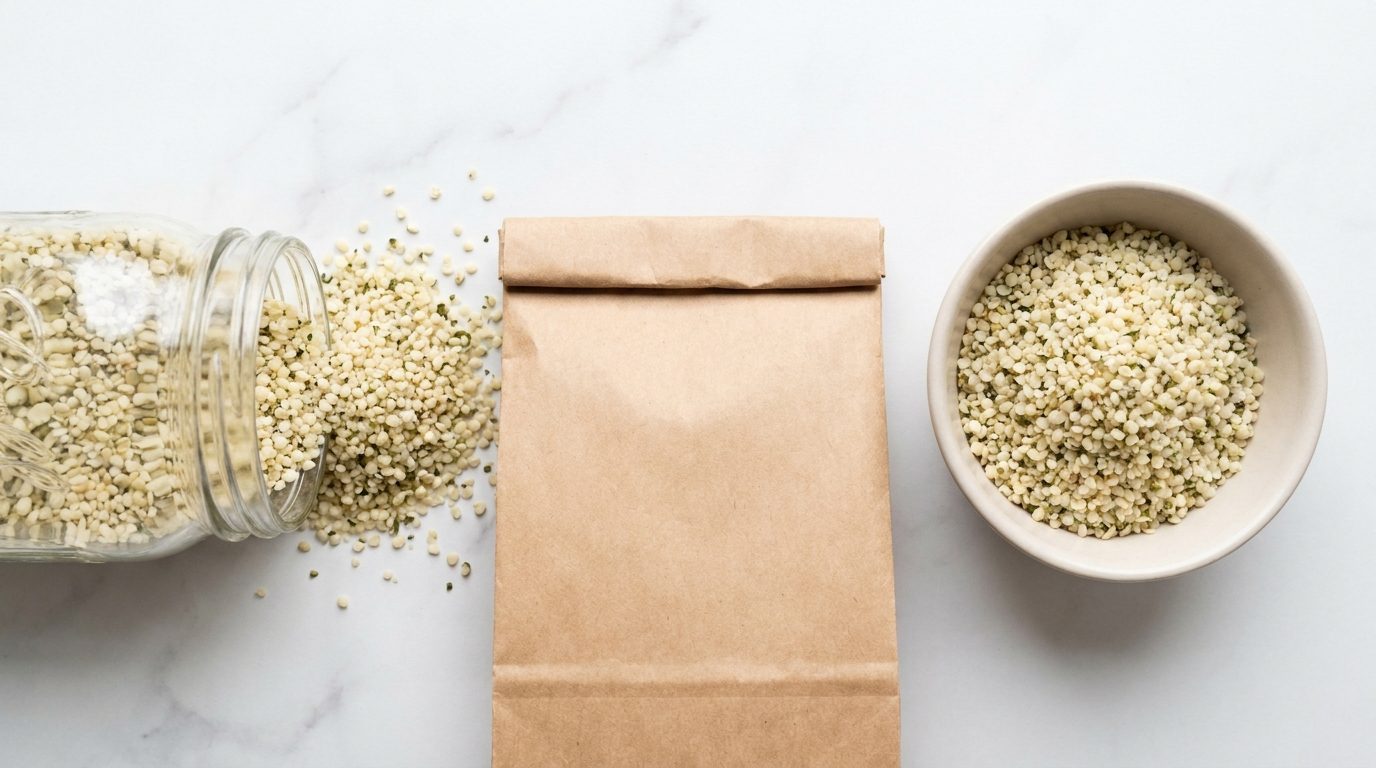
Hemp hearts, hulled hemp seed, shelled hemp seed and hemp nut all appear on shelves at the same time, frequently on bags of an identical product. Only one of those words tells you anything real about how the seed was processed.
Why does one seed carry four names?
A hemp seed is a small, roughly round achene: a firm outer hull wrapped around a soft, oil-rich kernel. Take the hull off and the kernel is what remains. Every one of the common names is pointing at that same kernel; they simply arrived from different directions.
"Hulled" and "shelled" are processing words borrowed from the grain and nut trades, and they describe an action performed on the seed. "Hemp hearts" is a consumer-facing name that stuck because it sounds like food rather than like a factory step, and because it distinguishes the product instantly from whole seed. "Hemp nut" turns up mostly in older trade paperwork and in some European markets.
Because all four describe the same physical thing, the name on the front of a bag is not a specification. The useful information is on the back: the ingredient statement, the country of origin, the packaging format and the best-before date.
What does "hulled" actually describe?
The hull is fibrous, gritty and accounts for a substantial share of the whole seed's weight. Removing it is a mechanical job. Seed is cleaned of stems, dust and foreign material, graded by size so that the cracking step can be tuned, then fractured — typically by throwing the seed against a hard surface at speed, or passing it between rollers set to split the shell without crushing the kernel. Hull fragments are then separated from kernels by air streams and screens, since the two differ in density and shape.
No solvent is involved and no cooking step is required. Because the separation is purely physical, it is never absolutely complete. A bag of hearts always contains some small percentage of hull fragments, and processors grade product largely on how little hull remains. Occasional dark flecks and the odd crunchy shard are normal carryover, not spoilage or adulteration. A product that feels persistently gritty across every spoonful is simply a coarser grade.
Is "hemp nut" a different product?
It is not. The word is a description of eating quality rather than botany — the kernel is soft, mild and faintly nutty, so "nut" was an easy shorthand. Hemp is not a tree nut and not a peanut, and the seed is botanically an achene, the same structure as a sunflower seed.
That distinction matters if you cook for someone with allergies. The name on the bag does not imply any relationship to tree nut proteins. What does matter is shared equipment: hemp hearts are often packed in facilities that also handle nuts and seeds, so read the allergen statement rather than reasoning from the product name. Hemp seed allergy itself exists but is uncommon.
What about whole hemp seed, sterilized seed and birdseed?
Whole hemp seed is the same seed with the hull left on. It is crunchier, noticeably more fibrous, and behaves completely differently in food — it will not melt into yogourt or oatmeal the way hearts do. The trade-offs between the two forms are worked through across our other articles.
You may also encounter seed described as sterilized or heat treated. In a number of jurisdictions, hemp seed crossing borders or destined for certain uses must be rendered incapable of germination. That treatment applies to whole seed; a dehulled kernel cannot sprout in any case. Separately, whole hemp sold as birdseed is cleaned and handled to a feed standard rather than a food standard. It is not an economical substitute for food-grade seed, and should not be treated as one.
Toasted, sprouted, raw: which of these words mean anything?
Toasted hemp seed is nearly always whole seed that has been dry roasted, which deepens the flavour and hardens the texture. Hearts are rarely toasted commercially because their fat is delicate and their texture is the point.
"Raw" on a bag of hearts usually just means no roasting step was applied — which is true of most hearts anyway, since hulling is mechanical. It is a weak claim rather than a false one. "Sprouted" deserves scepticism on a hulled product, for the reason given above. And "cold-pressed" belongs to oil, not to seed: if it appears on a bag of hearts it is borrowed language and tells you nothing.
How do you tell what you are actually buying?
| Term on the package | What it usually means | What to check |
|---|---|---|
| Hemp hearts / hulled hemp seed / shelled hemp seed / hemp nut | Dehulled kernels, no other processing | Best-before date, hull carryover, packaging |
| Whole or unhulled hemp seed | Hull intact, crunchy and fibrous | Whether it is sold as food grade |
| Toasted hemp seed | Usually whole seed, dry roasted | Whether it is hulled or not |
| Hemp protein powder | Milled cake left after oil pressing | Protein percentage stated on the panel |
| Hemp seed oil | Pressed oil only, no solids | Dark bottle, refrigeration advice |
The practical takeaway is to stop reading the front of the bag as a product grade and start reading it as a name. Once you have established that you are holding dehulled kernels, judge the product the way you would judge any high-fat seed: check the date, prefer packaging that blocks light and air, and when you open it, smell it. Fresh hearts smell green and faintly grassy with a soft nuttiness. If the first impression is sharp, waxy or like old paint, the name on the front will not save it.